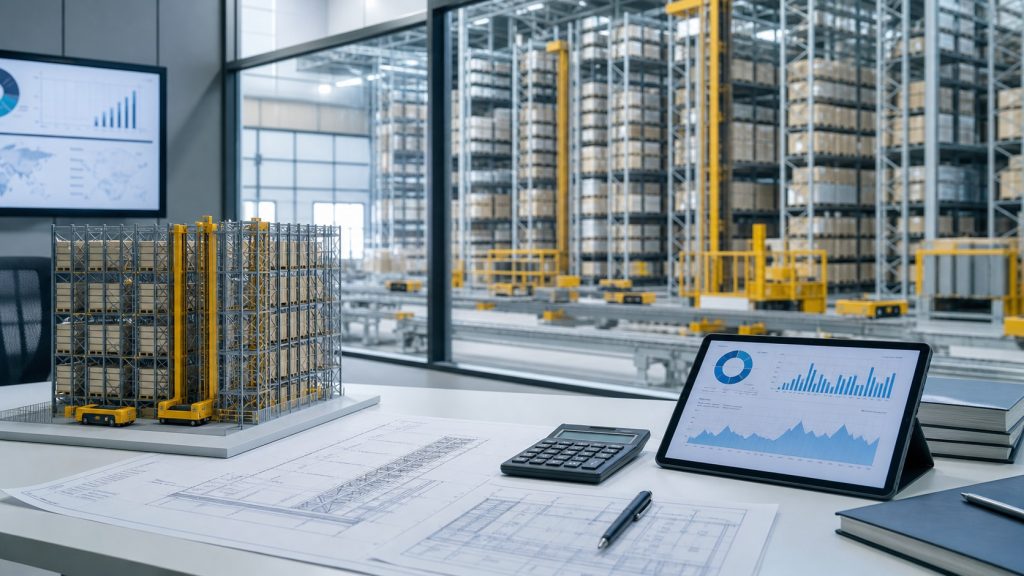
An automated storage and retrieval system does not have a meaningful one-price answer. Two warehouses with the same number of pallet positions can require very different investments because throughput, building height, temperature, pallet quality, redundancy and software integration change the engineering scope.
A responsible AS/RS cost estimate starts with operational data and separates the project into clear cost groups. This guide explains what drives the budget, which costs are frequently missed and how to build an ROI model that can be tested before approval.
What is included in an AS/RS project cost?
- Storage structure: racking, shuttle tracks, platforms, guards and structural reinforcement.
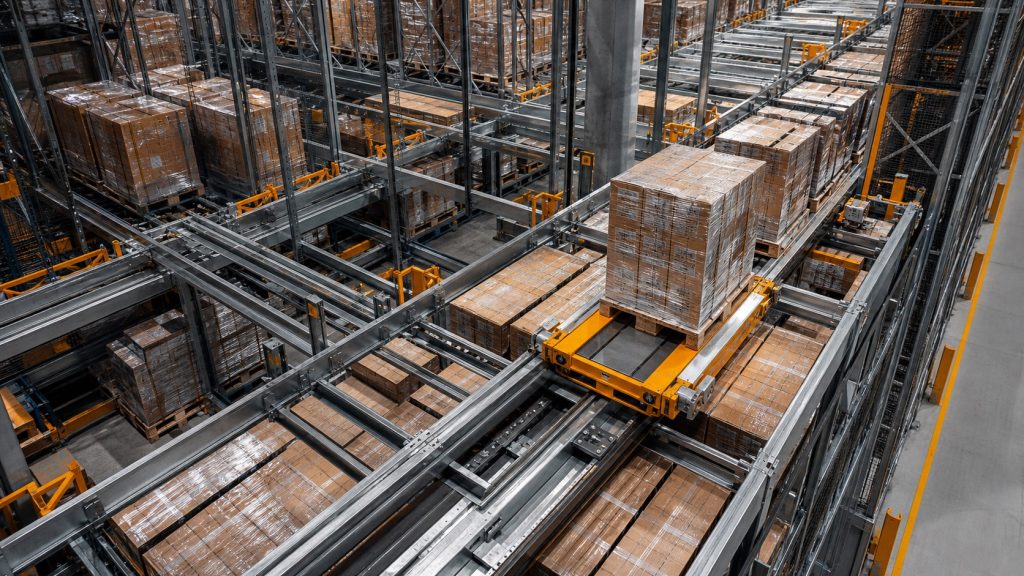
- Automation equipment: four-way shuttles or cranes, pallet lifts, conveyors, AGVs, workstations and charging equipment.
- Controls and software: PLC controls, WCS, WMS functions, interfaces, servers, networks and cybersecurity requirements.
- Building works: floor preparation, power, fire protection, refrigeration interfaces, fencing and access routes.
- Engineering and delivery: layout design, simulation, manufacturing, freight, installation, testing, training and commissioning.
- Lifecycle support: preventive maintenance, spare parts, software support, batteries and future upgrades.
Quotes should state which of these items are included, excluded or supplied by the customer. Comparing only the robot or rack price can hide a large part of the actual project budget.
Eight factors that have the greatest cost impact
1. Required pallet positions
Capacity affects rack volume, steel quantity, controls and installation. Cost per position may decline as systems grow, but only when additional capacity does not require disproportionate lifts, fire zones or building changes.
2. Peak throughput
Peak pallet movements determine shuttle quantity, lift capacity, conveyors and workstations. Designing from daily averages can produce an inexpensive system that fails during shift changes, production peaks or dispatch cutoffs.
3. Warehouse height and geometry
High-bay storage can reduce footprint, but taller structures require more engineering, stronger components, vertical transport and compliance work. Columns, roof trusses, doors and fire lanes also affect the usable grid.
4. Storage depth and SKU profile
Multi-deep storage improves density but can increase reshuffling when many SKUs have shallow inventory. The design should use inventory by SKU, turnover and batch rules to balance density with accessibility.
5. Temperature and environment
Frozen storage requires low-temperature components, suitable batteries, sensors, lubrication, condensation control and maintenance procedures. Chemical, dusty or controlled environments may add material and protection requirements.
6. Availability and redundancy
Additional lifts, bypass routes, standby equipment and recovery tools increase capital cost but reduce operational exposure. The correct level depends on the financial impact of one hour of lost production or dispatch.
7. Software integration
Connecting WMS and WCS to ERP, MES, TMS, production planning, quality systems and customer platforms requires interface design and testing. Complex exception handling often costs more than simple master-data exchange.
8. Local delivery conditions
Freight, taxes, installation labor, permits, site access and customer safety rules vary by country and facility. International projects should define responsibilities, local standards and acceptance criteria before the final commercial comparison.
A practical AS/RS ROI formula
Start with annual quantifiable benefits: direct labor reduction, avoided overtime, floor-space savings, reduced third-party storage, lower product damage, fewer inventory errors, energy savings and additional gross margin made possible by higher throughput.
Then subtract annual operating costs such as maintenance, support, spare parts, batteries and added technical labor. Simple payback can be calculated as total project investment divided by annual net benefit. For larger projects, use discounted cash flow, net present value and internal rate of return over the expected system life.
The model should include a conservative ramp-up period. During installation and commissioning, a facility may carry temporary labor, dual operations or reduced productivity. These transition costs belong in the business case.
Costs buyers commonly overlook
- Pallet replacement or quality-control equipment.
- Floor flatness, reinforcement and building alterations.
- Fire detection, sprinklers and insurance requirements.
- Network infrastructure and server policies.
- Master-data cleanup and ERP interface testing.
- Operator, technician and safety training.
- Temporary operations during cutover.
- Critical spare parts and maintenance access equipment.
How to request comparable quotations
Give every supplier the same data set: layout drawings, pallet specifications, SKU-level inventory, inbound and outbound history, peak-hour requirements, working calendar, temperature, interfaces and acceptance targets. Ask for guaranteed throughput, equipment quantities, exclusions, power demand, maintenance scope and an implementation schedule.
Request alternatives where useful. A base design, growth design and high-availability design reveal how investment changes with capacity and risk. This is more useful than negotiating one unexplained lump-sum quotation.
Frequently asked questions
Can AS/RS cost be estimated from pallet positions alone?
Only as a rough early benchmark. Throughput, height, environment, interfaces and building work can change the budget substantially. A decision-grade estimate requires operational data and a preliminary layout.
What usually improves AS/RS payback?
High labor cost, limited space, expensive refrigerated volume, repetitive pallet movements, multiple shifts and measurable error or damage costs tend to strengthen the business case.
Build the budget from a preliminary design
An AS/RS budget becomes credible when it is tied to a layout, equipment list, throughput model and interface scope. SAFER designs smart AS/RS warehouses with four-way shuttle robots and integrated SA-WMS and AI-WCS. Send your warehouse dimensions and operating data to receive an engineering-based configuration.