A four-way shuttle system is a high-density automated storage and retrieval solution for palletized goods. Unlike a conventional radio shuttle that travels in only one direction, a four-way shuttle can move both lengthwise and crosswise through the rack structure. Combined with lifts, conveyors, sensors, a warehouse management system and real-time equipment control, it can reach almost any storage location without relying on a stacker crane in every aisle.
This guide explains how a four-way shuttle system works, the main components, where it creates value and what data a warehouse operator should prepare before requesting a system design.
How does a four-way shuttle system work?
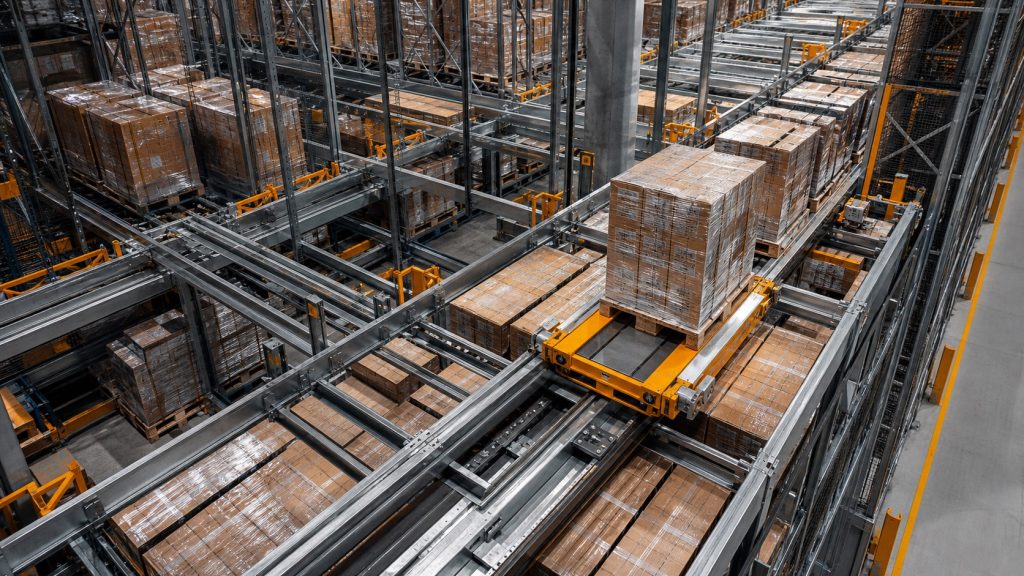
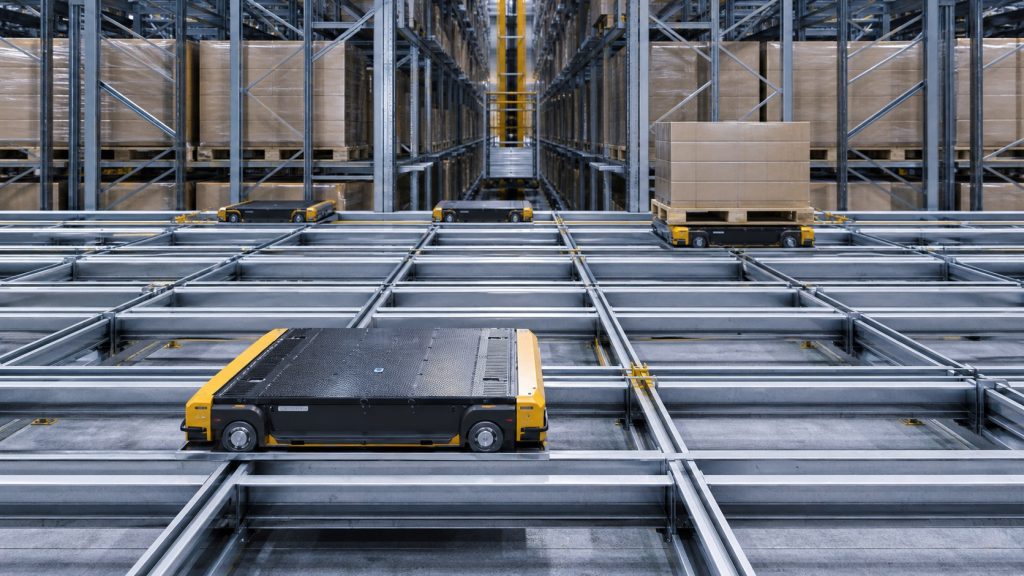
The shuttle runs on rails installed inside the pallet racking. It travels under a pallet, raises its lifting platform, collects the load and transports it to another storage position, a transfer point or a lift. Because the vehicle can change direction at rail intersections, one shuttle can serve multiple lanes rather than remaining trapped in a single channel.
Vertical lifts connect the rack levels. At the inbound station, pallet dimensions, weight and identification data are checked before the load enters the automated area. The WMS assigns a storage location, while the WCS selects the available shuttle, lift and route. During outbound operations, the same process runs in reverse and delivers the required pallet to a conveyor, picking station or AGV interface.
The six main components
- Four-way shuttle robots: autonomous vehicles that transport pallets along both rack axes.
- High-density racking: the structural storage system and precision running track for the robots.
- Vertical lifts: equipment that transfers shuttles or pallets between levels.
- Conveyors and workstations: the interfaces for receiving, picking, staging and dispatch.
- SA-WMS: the inventory layer that manages inbound, outbound, locations, FIFO and traceability.
- AI-WCS: the real-time control layer that schedules equipment, plans routes and prevents conflicts.
The quality of the complete system matters more than the specification of any single component. A fast shuttle cannot compensate for a slow lift, poor rack tolerances or weak scheduling logic. For that reason, system throughput should be simulated with the expected order profile rather than estimated from shuttle speed alone.
Key benefits for warehouse operations
Higher storage density
Four-way shuttles support multi-deep storage and reduce the number of fixed travel aisles. This makes them valuable where floor area is limited, land is expensive or refrigerated volume must be minimized. The final density depends on pallet dimensions, SKU mix, inventory depth, fire regulations and access requirements.
Flexible capacity
Throughput can often be increased by adding shuttles or adjusting scheduling rules instead of rebuilding the entire rack system. Multiple robots can work across several levels, while the WCS distributes tasks according to workload, battery status and equipment availability.
Reduced single points of failure
A conventional crane is normally dedicated to an aisle. A four-way shuttle fleet is more distributed: another robot can frequently take over work in a different lane or level. Good design still requires lift redundancy, recovery procedures and accessible maintenance zones, but the architecture can be more resilient.
Wide environmental range
Purpose-built shuttle systems can operate in frozen cold stores as well as ambient manufacturing warehouses. SAFER four-way shuttle configurations cover working environments from -25°C to 50°C, with positioning accuracy up to ±2 mm and options for different pallet sizes and load profiles.
Where is a four-way shuttle system most suitable?
The system is especially effective for pallet operations that require high storage density, automated replenishment and scalable throughput. Common applications include frozen food, chilled goods, pharmaceuticals, automotive components, new-energy materials, chemicals, appliances, packaging and bulky furniture parts.
It is not automatically the best choice for every warehouse. A low-throughput facility with abundant floor space may achieve a better return from selective racking and forklifts. Operations dominated by individual-item picking may need tote automation, AMRs or a hybrid solution. Very high throughput concentrated in a small number of aisles may favor a crane-based AS/RS. The decision must follow data, not equipment trends.
Four-way shuttle vs. traditional radio shuttle
A traditional pallet shuttle usually works inside one storage lane and is repositioned by a forklift or carrier. It offers dense storage but depends more heavily on manual handling. A four-way shuttle changes direction independently, connects with lifts and runs under WMS/WCS control. This enables fully automated pallet movement across the storage grid.
The four-way system therefore requires a higher level of engineering and software integration, but it provides greater automation, flexible routing and fleet scalability. Buyers should compare complete lifecycle cost, expected throughput, maintenance resources and expansion plans rather than only the initial equipment price.
Data required for a reliable system proposal
- Warehouse length, width, clear height and column grid.
- Pallet dimensions, maximum load and pallet quality standard.
- Number of SKUs and average inventory by SKU.
- Required pallet positions and future growth target.
- Peak inbound and outbound pallets per hour.
- FIFO, FEFO, batch and expiry requirements.
- Temperature, humidity, dust and fire-protection conditions.
- Current ERP, MES, TMS or WMS interfaces.
- Picking, production-line delivery and dispatch workflows.
- Availability, redundancy and maintenance expectations.
Providing these inputs early allows engineers to determine rack depth, shuttle quantity, lift capacity, charging strategy and software interfaces. It also makes competing proposals easier to compare on equal terms.
Frequently asked questions
Can one shuttle serve multiple rack levels?
Yes. A shuttle lift can transfer the robot between levels, while pallet lifts may handle loads separately. The preferred arrangement depends on throughput and redundancy requirements.
How many shuttles does a warehouse need?
There is no fixed ratio. Quantity should be calculated from peak pallet movements, travel distance, lift cycles, charging time, availability target and the order profile. Simulation is the most reliable method.
Can the system integrate with an existing ERP?
Yes. The WMS normally exchanges master data, inventory and order information with ERP, MES, TMS or OMS platforms through agreed interfaces. Interface scope should be defined before implementation.
Plan the system around your operation
A four-way shuttle system delivers the greatest value when rack design, robots, lifts and software are engineered as one operating system. If you are evaluating a project, start with the warehouse data above and compare suppliers on demonstrated throughput, recovery procedures, integration capability and delivered references. Explore SAFER’s 3D four-way shuttle robots, smart AS/RS systems and SA-WMS and AI-WCS platform, or contact our engineering team to discuss a warehouse layout.