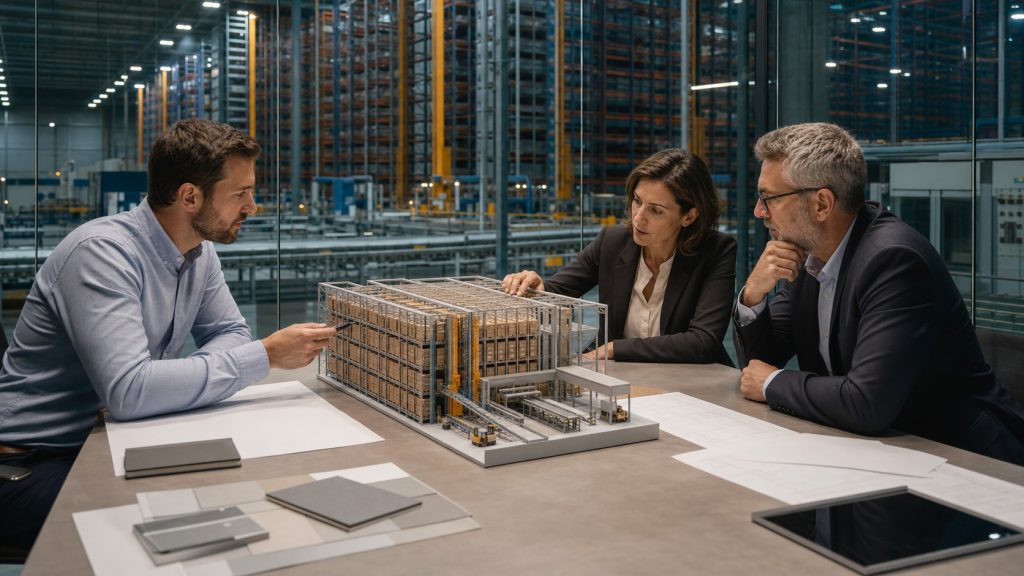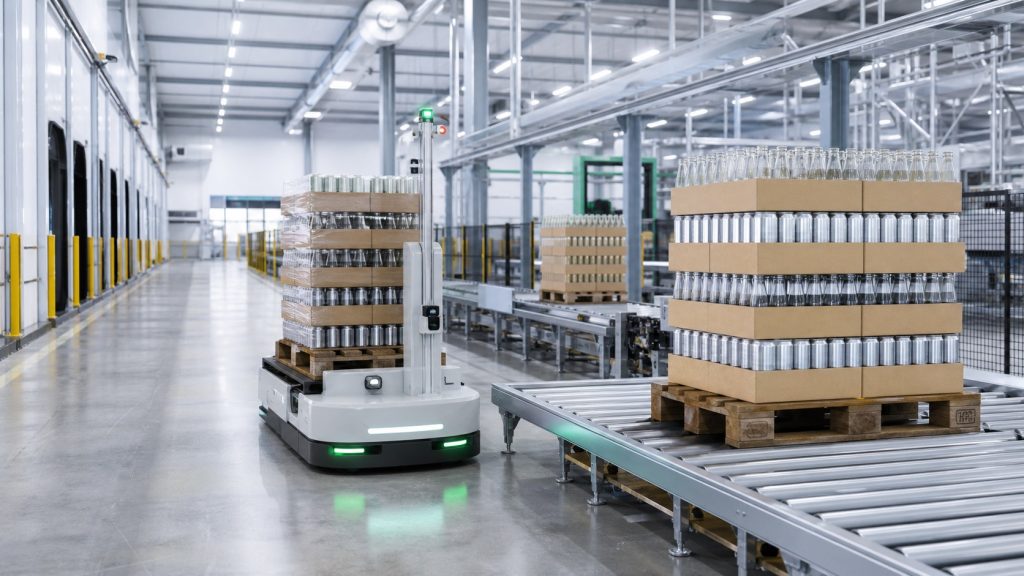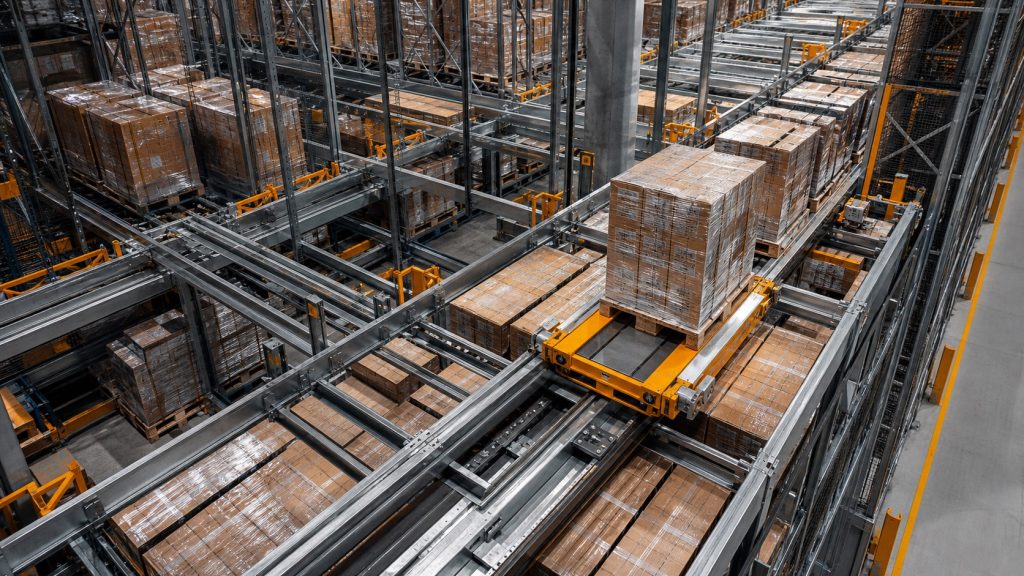
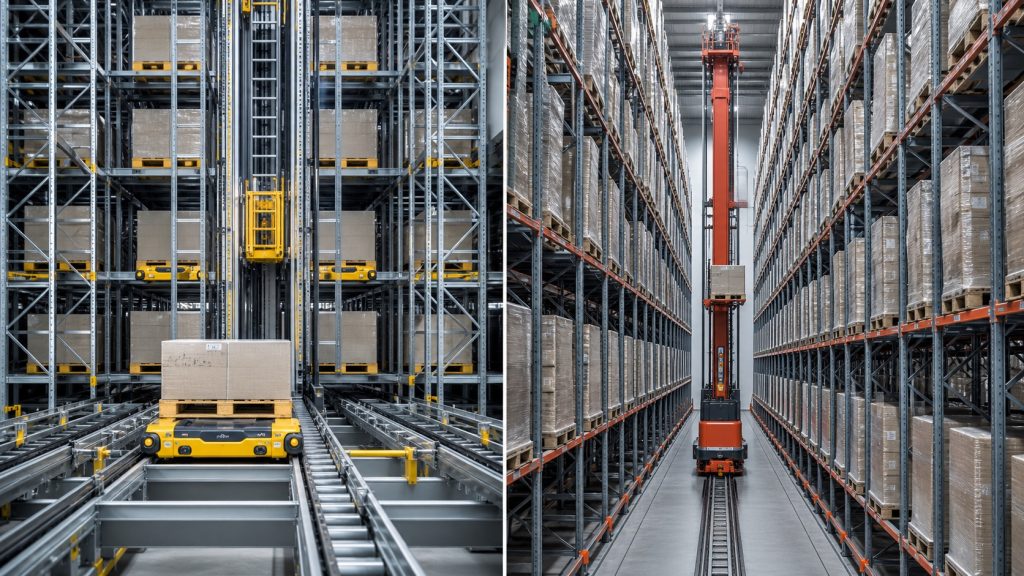
Four-way shuttle systems and stacker crane AS/RS solutions can both automate pallet storage, but they solve the problem in different ways. A stacker crane normally serves a dedicated aisle and moves horizontally and vertically on a fixed mast. A four-way shuttle travels through the rack grid, changes direction at intersections and uses lifts to move between levels.
The right choice depends on storage density, throughput distribution, building geometry, redundancy, expansion plans and lifecycle cost. This comparison gives warehouse owners a practical framework for selecting the more suitable architecture.
How the two AS/RS designs differ
In a stacker crane system, each crane typically operates in one aisle. The machine combines horizontal travel and vertical lifting, placing or retrieving pallets from locations on either side. This mature architecture can deliver high throughput when pallet movements are concentrated in clearly defined aisles.
In a four-way shuttle AS/RS, compact robots move horizontally inside the rack. Separate lifts provide vertical transport. The WCS coordinates multiple shuttles and lifts as a fleet, allowing routes and task allocation to change with demand.
Storage density and building use
Both systems can use warehouse height effectively. Stacker cranes require a travel aisle for every crane, while a four-way shuttle system can support multi-deep storage with fewer dedicated aisles. For facilities where footprint or refrigerated volume is expensive, the shuttle design can provide an important density advantage.
Stacker cranes are often attractive in long, straight, purpose-built high-bay buildings. Four-way shuttles adapt well to irregular columns, multiple storage zones, existing buildings and phased projects. However, the rack grid and running tracks require precise engineering; flexibility does not eliminate the need for structural accuracy.
Throughput: calculate the whole system
Comparing maximum travel speeds is misleading. A stacker crane may complete rapid combined horizontal and vertical movements, but each aisle depends on its assigned crane. A shuttle fleet can perform many movements in parallel, although lifts and transfer stations may become bottlenecks.
Reliable throughput analysis must include peak inbound and outbound demand, SKU distribution, average travel distance, lift cycles, pallet inspection time, workstation capacity and charging. Simulation using actual order data is preferable to a calculation based only on equipment speed.
Redundancy and maintenance
If a stacker crane stops, access to its aisle may be restricted until recovery. Suppliers can reduce this risk through proven components, preventive maintenance and emergency procedures, but the aisle remains closely tied to one machine.
A shuttle system distributes work across several robots. If one unit requires service, the WCS can often reassign tasks to other vehicles. The design must still address lift redundancy, blocked tracks, battery management and safe access. Buyers should ask both suppliers to demonstrate fault recovery, not merely quote availability percentages.
Scalability and future expansion
Four-way shuttle capacity can often be increased by adding robots, expanding rack zones or adjusting scheduling rules, provided lifts and stations have spare capacity. This is useful when demand is uncertain or automation will be deployed in phases.
Stacker crane systems can also be expanded, but additional capacity commonly requires another aisle, crane and associated controls. For a stable, well-defined flow, that structure may be efficient. For changing SKU profiles and phased capital investment, the shuttle approach may offer more options.
Cost and total ownership
Neither technology is always cheaper. Initial cost is influenced by rack height, pallet positions, shuttle or crane quantity, lifts, conveyors, fire protection, building work and software integration. Operating cost includes power, preventive maintenance, spare parts, support, battery replacement and downtime risk.
A useful comparison should use the same design horizon and service level. Calculate cost per pallet position, cost per required pallet movement and the value of floor-space savings. Include expected expansion and the operational impact of maintenance. A low quotation that cannot meet peak throughput is not a low-cost solution.
Quick selection guide
- Consider a four-way shuttle system when: density is critical, SKU demand changes, expansion will be phased, the building is irregular or distributed redundancy is valuable.
- Consider a stacker crane AS/RS when: the building has long straight aisles, flows are stable, very high movements are concentrated by aisle and a proven crane architecture fits the operation.
- Consider a hybrid system when: reserve storage, production supply, picking and dispatch have different flow profiles that one technology cannot serve efficiently.
Questions to ask every AS/RS supplier
- What throughput is guaranteed at the defined peak order profile?
- Which component becomes the bottleneck first?
- What happens when a shuttle, lift or crane fails?
- How can technicians access and recover equipment safely?
- Which ERP, MES and WMS interfaces are included?
- How can capacity be expanded after commissioning?
- Which comparable projects can be referenced?
Frequently asked questions
Is a four-way shuttle always denser than a stacker crane?
Not always. Density depends on rack depth, pallet clearances, fire codes, access rules and SKU inventory. The final layout must be compared using the same building and capacity requirement.
Which system is better for cold storage?
Both can work in cold environments. Four-way shuttle systems are attractive when reducing refrigerated volume and manual access is a priority. Equipment specifications, batteries, sensors, lubrication and maintenance procedures must be designed for the target temperature.
Choose from operational data, not a generic ranking
The strongest AS/RS proposal connects technology to measurable requirements. Before choosing, provide the same warehouse dimensions, pallet data, SKU profile and peak flows to each supplier and request a documented throughput model. SAFER engineers integrated smart AS/RS systems using 3D four-way shuttle robots, lifts and SA-WMS and AI-WCS. Contact the engineering team for a layout assessment based on your data.