Cold storage automation must solve more than pallet movement. Low temperatures reduce battery performance, change lubrication behavior, affect sensors and electronics, create condensation risk and make manual recovery slower and less comfortable. A system that works in an ambient warehouse cannot simply be installed in a freezer without engineering changes.
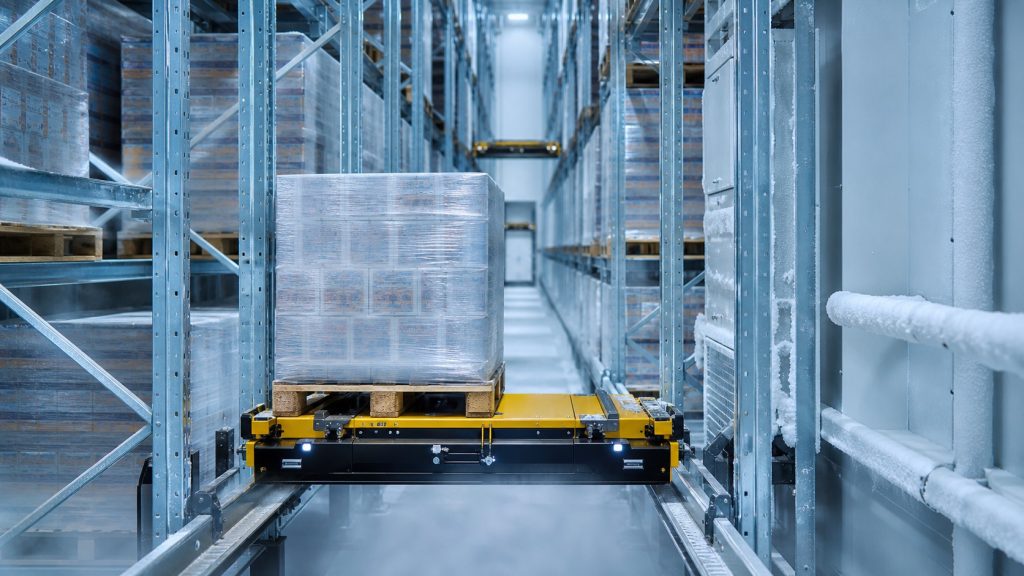
Four-way shuttle AS/RS technology is well suited to frozen and chilled storage because it combines dense racking, unmanned pallet transport and flexible robot scheduling. This guide explains the main design requirements for reliable operation down to -25°C.
Why automate a cold store?
Every cubic meter of frozen space requires ongoing refrigeration energy. High-density AS/RS layouts reduce unnecessary aisles and can store more pallets inside a smaller refrigerated envelope. Automation also limits forklift traffic, reduces door opening and keeps personnel away from extended low-temperature exposure.
The business case is strongest when a facility has high storage cost, repetitive pallet movements, strict FIFO or FEFO rules, labor constraints and a need for accurate batch traceability. Food, frozen ingredients, meat, dairy, pharmaceuticals and temperature-sensitive materials are common applications.
What changes at -25°C?
Battery capacity and charging
Low temperature can reduce available battery capacity and charging efficiency. Shuttle quantity and charging strategy must be calculated using cold-environment performance, not room-temperature data. Charging may occur in a controlled area or use equipment specifically designed for the freezer zone.
Lubrication and mechanical components
Grease, hydraulic fluids, seals, cables and plastics must remain suitable at the design temperature. Increased viscosity or brittle materials can affect lifting time, travel resistance and service life. Component specifications should state the actual continuous operating range.
Sensors and electronics
Positioning sensors, RFID readers, laser devices, motors and control electronics require low-temperature ratings and protected enclosures. Cable routing and connectors should be designed to prevent moisture ingress and allow maintenance without damaging cold-stiffened parts.
Condensation and transitions
Moving equipment between cold and warm zones can create condensation. The layout should minimize uncontrolled temperature transitions and define procedures for equipment removal, repair and return. Air locks, staging areas and suitable waiting periods may be required.
Core design requirements
- Temperature-rated shuttle: motors, batteries, lifting system, sensors and materials selected for continuous cold operation.
- Precision rack tracks: stable geometry and accurate installation across the expected temperature range.
- Low-temperature lifts and conveyors: components designed as part of the same throughput model.
- Automatic charging: enough charging capacity and standby energy for peak demand.
- Pallet inspection: detection of damaged, oversized or unstable pallets before entry.
- Safe recovery access: defined routes, tools, protective clothing and lockout procedures.
- WMS rules: FIFO, FEFO, batch, expiry, quarantine and temperature-zone management.
- WCS scheduling: route optimization, congestion prevention, battery status and equipment fault handling.
FIFO, FEFO and traceability
Cold-chain inventory often has shelf-life, production-batch and quality-hold requirements. The WMS should decide where each pallet is stored and which pallet is released, while preserving lot and expiry data. The WCS then executes the movement through shuttles, lifts and conveyors.
Exception processes are as important as normal flow. The design should cover rejected pallets, temperature excursions, quality quarantine, expired stock, partial dispatch and manual inventory corrections. These rules should be tested during acceptance, not left for operators to solve after go-live.
Throughput and redundancy in a freezer
Peak demand may occur when production finishes a batch or outbound trucks arrive within a narrow window. Calculate shuttle and lift capacity from those peaks. Include derating for cold conditions, charging and planned defrost or maintenance windows where applicable.
Recovery takes longer in a freezer, so fault strategy deserves special attention. Multiple shuttles provide distributed capacity, but lifts, conveyors and access points can still stop flow. Consider standby equipment, bypass routes, critical spares and remote diagnostic support based on the cost of downtime.
Maintenance planning
Preventive maintenance should be temperature-specific. Inspection intervals, lubrication, battery checks, wheel and rail condition, sensor cleaning and fastener checks must follow the actual duty cycle. The facility should maintain critical spares and train technicians in safe cold-room entry and equipment recovery.
Remote alarms and digital equipment status reduce unnecessary entry. A WCS that records faults, task history and charging behavior helps maintenance teams identify developing problems before they become extended downtime.
Data to provide for a cold storage proposal
- Operating and minimum design temperature.
- Warehouse dimensions, insulation and door locations.
- Pallet sizes, weights and quality standards.
- SKU, batch and shelf-life profile.
- Required positions and peak pallet movements.
- FIFO, FEFO and quarantine rules.
- Existing refrigeration and fire-protection design.
- Maintenance access and recovery requirements.
- ERP, WMS and production-system interfaces.
Frequently asked questions
Can lithium batteries work at -25°C?
Suitable battery systems can operate in low-temperature applications, but usable capacity, charging method and thermal management must be confirmed for the specific cell, enclosure and duty cycle.
Does cold storage need a separate WMS?
Not necessarily. The warehouse platform must support the required zones, batches, expiry dates, quarantine and interfaces. Whether this is a dedicated system or an integrated enterprise WMS depends on the wider architecture.
Engineer the cold environment as one system
Reliable freezer automation comes from matching mechanical design, batteries, sensors, racking, software and maintenance procedures to the same temperature and duty cycle. SAFER four-way shuttle solutions are available for environments down to -25°C and integrate with high-density AS/RS racking and SA-WMS and AI-WCS. Review the 3D shuttle specifications or send the engineering team your cold-store data for a preliminary configuration.